Identity, names, and legal proof
The LuminariesIdentity, names, and legal proof form one of the novel’s central mechanisms of uncertainty: people assume identities, documents carry competing claims, and what a record can establish depends on its history and interpretation. The forged and missing papers surrounding Francis Carver and Crosbie Wells shape the shipping-crate mystery, obstruct Lydia Wells’s inheritance claim, and ultimately enable Walter Moody to expose a false signature in court.
Names and the missing crate
In June 1865, a scarred man entered Benjamin Löwenthal’s office on Weld Street to advertise for a missing shipping crate. He offered twenty pounds for its return, or fifty if it came back unopened, but declined to give his name. Instead, he produced a birth certificate, which Löwenthal used to record him as Crosbie Francis Wells. The man directed anyone who found the crate to an address on Gibson Quay. Its contents were not specified in the advertisement; the caller described them only as items of great personal value.
Löwenthal’s recollection of the encounter rests on an unusually precise piece of newspaper history. When setting the advertisement, he found that it exceeded the space the caller had paid for by one word. The last word, Wells, would have been stranded at the top of a third column, so Löwenthal removed the middle name, Francis. The caller returned the next morning, objected strongly to the alteration, and insisted that his full name be printed. Because the man had bought a week of advertising, Löwenthal reprinted the notice and offered an additional printing without charge. That correction, initially a small dispute over typesetting, later helped identify the caller.
The notice belonged to a larger attempt to recover a fortune. Carver had taken Alistair Lauderback’s ship, the Godspeed, and subsequently lost the crate that had helped him force Lauderback’s hand. The crate held a trunk containing about four thousand pounds in gold, sewn into the linings of five dresses by Lydia Wells, who was then posing as Carver’s wife. Carver travelled to Hokitika, apparently supposing the crate had been delivered there by mistake, and advertised for it under the name Crosbie Francis Wells. The reason he possessed that birth certificate, and the precise advantage he expected to gain by using the identity, remained uncertain.
Documents as clues and disguises
The relationship between Carver and the borrowed name becomes visible again in the sale of the Godspeed. In a trunk belonging to Lauderback, Moody found the deed recording the ship’s transfer in May 1865 to a purchaser named Francis Wells. The signature was written with an expansive flourish before the capital F, and a dot between the apparent C and F made it possible to read the name as C. Francis Wells. Moody judged the ambiguity deliberate: it could connect the transaction to Crosbie Wells while giving Carver room to deny that he had signed the name in that form.
The documents also point to different versions of the impersonation. Carver had presented himself as Crosbie Francis Wells to Löwenthal in June, but had called himself Francis Wells when dealing with Lauderback the month before. Moody inferred that Carver may have posed to Lauderback as Crosbie Wells’s brother, especially because Lauderback had privately believed that the two men were brothers. That interpretation links the alias to a relationship concealed from others, but at this stage it does not resolve why Carver adopted it or whether every document associated with the name was genuine.
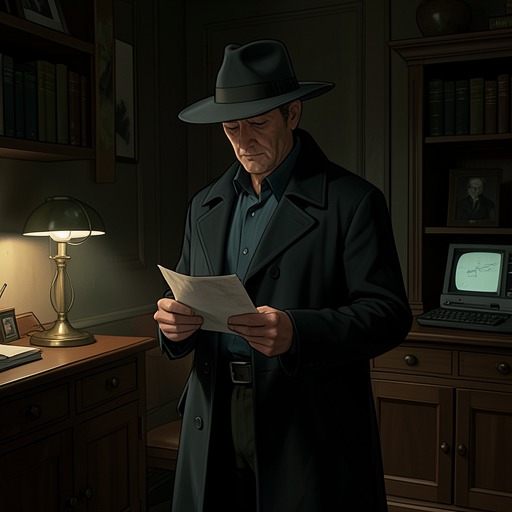
A bundle of letters hidden beneath the lining of Lauderback’s trunk supplied a different kind of proof. One letter, written in 1852 and signed Crosbie Wells, stated that its author was the illegitimate son of Lauderback’s father and therefore Lauderback’s brother. The writer explained that he had been raised under the name Crosbie Wells, taken from his parish priest, and had learned of his father only later. He described travelling to Dunedin, mistaking Lauderback for his father before recognizing him as his brother, and asking for help to return home. The letter established a family connection in Crosbie Wells’s own account, while also revealing why Lauderback might have had reason to keep that connection private. It did not, by itself, settle every question of identity attached to the birth certificate or the ship’s bill of sale.
The legal force of absence
The absence of a document could be as consequential as the presence of one. Lydia Wells’s appeal against the sale of Crosbie Wells’s estate was delayed because no surviving papers from the dead man could establish that the hermit buried in the Arahura Valley was the same Crosbie Wells named on her marriage certificate. Lydia had arrived after the funeral and had not identified the body. Without a document connecting the deceased man to her husband, the Magistrate’s Court could not confidently resolve the claim; the magistrate postponed proceedings while seeking firmer proof.
The uncertainty mattered because the estate contained a fortune. After Edgar Clinch commissioned Harald Nilssen to clear the cottage, Nilssen discovered gold valued at a little over four thousand pounds. Once commission, taxes, and expenses had been deducted, the remainder was held in escrow at the Reserve Bank while Lydia challenged Clinch’s purchase. The gold made the question of identity a material dispute: establishing who the dead man was could determine who had a claim to his property. Yet the fortune’s appearance did not itself identify its owner, and the missing certificate remained an obstacle even as other evidence accumulated.
Meanwhile, the name on Carver’s advertisement and the gold concealed in the dresses intersected with further mistaken conclusions. Anna Wetherell wore the gold-bearing gowns without speaking of the hidden fortune. Edgar Clinch and Ah Quee separately discovered gold in the dresses and each supposed it was connected to Dick Mannering’s mining fraud. Ah Quee removed gold from four gowns, melted the dust into squares, and marked them with the Aurora name so the proceeds would be credited to that claim. The gold’s markings and movement could suggest a source or ownership, but they did not disclose the whole chain of possession. Anna later found the remaining gold in her orange dress after waking in gaol with no memory of the preceding twelve hours. In this network, objects and names provide clues, but neither automatically supplies a complete account.
Proof in court and narrative significance
The decisive documentary comparison came when Moody addressed the court. He argued that the signature on private correspondence from Crosbie Wells matched the signature on the October 1865 deed of gift concerning two thousand pounds for Anna Wetherell, witnessed by Crosbie Wells, and the signature on Lydia’s marriage certificate. Those signatures, he told the court, did not resemble the signature on the Godspeed bill of sale submitted by Carver. The comparison supported his conclusion that the ship’s bill of sale had been forged. A name on a legal paper was not enough: handwriting, provenance, and comparison with other documents changed what the name could prove.
The novel’s evidence is therefore neither a simple opposition between truth and falsehood nor a promise that every mystery can be settled by paperwork. The birth certificate gives Carver a usable identity, the altered newspaper notice helps Löwenthal remember how he obtained it, the concealed letters disclose kinship, and the missing certificate stalls Lydia’s case. Moody’s method is to assemble these fragments, distinguish what each can establish from what remains conjectural, and test signatures against one another. The repeated shifts between Crosbie Wells, Francis Wells, and Francis Carver make identity a matter of both social recognition and documentary proof: a person may live under a name, claim a name, or borrow one, but the consequences depend on who can verify the claim and which records survive.